
Prediction markets let you trade on the outcome of real-world events. Politics, sports, crypto, economics, culture, world events. Think something will happen? Buy a contract. Right, it pays out. Wrong, it's worthless. That's the whole idea.
This guide compares the best prediction markets available to US traders in 2026. We cover how they work and what they cost. We also cover whether they're legal where you live, and how they differ from a sportsbook. If you're mainly looking for traditional sportsbooks, see our guide to the best sports betting sites.
Best prediction market sites and apps
We compare four of the most relevant prediction market platforms for US users. They work differently, and one does not use real money at all.
Here's how the prediction market apps compare.
| Platform | Best For | Main Markets | US Access | Fees | Notes |
| Kalshi | Regulated event contracts | Economics, politics, sports, culture | Most states; sports contracts contested | Varies by market | DCM – Designated Contract Market |
| Polymarket | Fiat-based US event-contract exchange | Politics, crypto, world events, sports | availability varies by state; check current platform restrictions, KYC required | Varies by market | Runs via QCX, CFTC-regulated |
| PredictIt | Political forecasting | US Politics and elections | All 50 states | 10% on profits + 5% withdrawal fee | $3,500 position limit per contract |
| Manifold | Learning and forecasting | Broad, community-created | Available | No real-money fees | Play money, not real money |
One distinction matters more than any other here. Kalshi, Polymarket US and PredictIt trade real money. Manifold does not. Manifold runs on play currency, which makes it a genuinely useful place to learn without risking anything. Just don't confuse it with the others.
What are prediction markets?
A prediction market is a marketplace where people trade contracts tied to future events. Each contract asks a yes or no question. Will this candidate win? Will inflation top 3%? Will this team make the playoffs? You take a side. The CFTC guide to prediction markets is the official US source on how these event contracts are regulated.
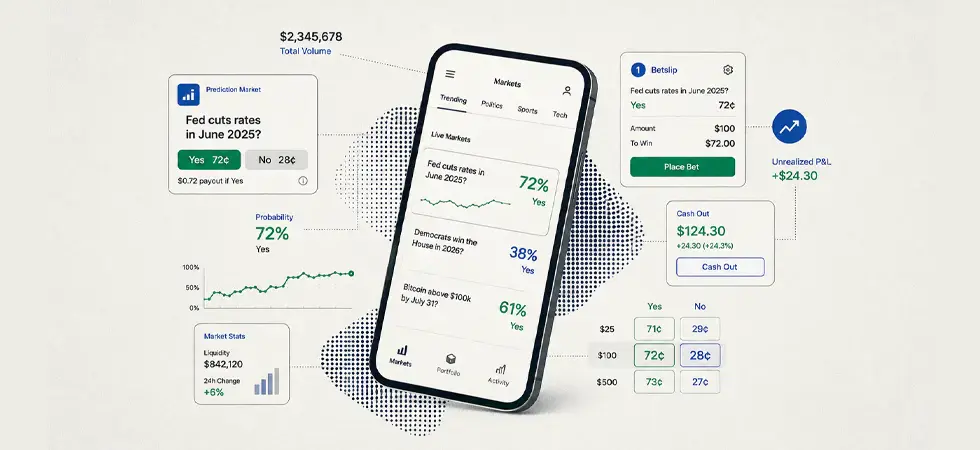
The clever part is the price. Contracts trade between $0 and $1. That price reflects what the market thinks the odds are.
Say a Yes contract trades at $0.65. The market is pricing that outcome at roughly a 65% chance. If the event happens, the contract settles at $1. If it doesn't, it settles at zero.
So the price is a probability. That's the appeal beyond the money. It's a live readout of what a crowd with real stakes believes.
How do prediction markets work?
The mechanics are simpler than they sound. Four steps.
1. A market is created
2. Traders buy and sell.
3. Prices move.
4. The market resolves.
The terms you'll meet
Yes/No contracts
Liquidity
Payouts
Are prediction markets legal in the US?
It depends on the platform, the contract type, and your state. The legal position is changing quickly, especially for sports-related prediction markets.
At the federal level, leading platforms operate through CFTC-regulated event-contract exchanges. Kalshi is a designated contract market, while Polymarket US operates through QCX, the CFTC-regulated exchange it acquired. That federal status does not automatically settle whether individual states can apply their own gambling laws to sports event contracts.
The biggest dispute is over sports event contracts that states view as sports betting. Several state regulators argue that platforms offering these contracts need the same state gaming licenses required by sportsbooks. Federal courts have now reached conflicting conclusions on how much authority states have.
On August 28, 2026, the U.S. Court of Appeals for the Ninth Circuit sided with Nevada. The court held that Kalshi had not shown that the federal Commodity Exchange Act preempts Nevada gaming laws as applied to its sports event contracts, allowing Nevada regulators to continue requiring state authorization. The decision conflicts with the Third Circuit's April 2026 ruling in KalshiEX LLC v. Flaherty, which found that the CFTC's jurisdiction over sports-related event contracts on a designated contract market preempted New Jersey's gambling rules. That circuit split means the core question of state versus federal authority remains unresolved and could ultimately require further appellate or Supreme Court review. Sources: Reuters, Aug. 28, 2026 and Third Circuit opinion in KalshiEX LLC v. Flaherty.

State restrictions therefore continue to change. Nevada is currently taking a restrictive approach to sports-related prediction contracts, and regulators in other states have also pursued legislation, enforcement actions, or litigation involving prediction-market operators.
Minnesota has also attempted to restrict prediction-market activity, while Arizona, Tennessee, Connecticut, Rhode Island, New York, Utah, and other states have considered or pursued legislation, enforcement, or court action. The exact position can differ by contract type, so a platform may face different rules for sports, political, or other event markets.
Meanwhile, the CFTC proposed a new framework in June 2026 addressing when event contracts, including sports-related contracts, may be contrary to the public interest. That proposal is not yet a final rule, so it does not resolve the current court disputes.
The practical answer is that federal regulation alone does not guarantee access in every state. Sports contracts face the most scrutiny, and the Ninth and Third Circuits currently interpret the state-federal divide differently. Before trading, we recommend checking both the platform's current state restrictions and the applicable state rules. For comparison, see our guide to legal sports betting in the USA.
California is a useful example. The state does not currently have legal state-regulated online sportsbooks, while prediction-market operators have faced separate challenges involving tribal and state gaming interests. Our California sports betting page covers the state's betting rules in more detail.
This content is for informational purposes only and is not legal, financial, or betting advice. Prediction-market access and legality can vary by platform, jurisdiction, and contract type. Always check current state rules and the platform's terms before participating.
Prediction markets vs sports betting
This is where it clicks for sports bettors. The two look alike. They behave very differently.
| Feature | Prediction Markets | Sports Betting |
| Pricing | Set by buyers and sellers | Set by the sportsbook |
| User action | Trade contracts before resolution | Place a fixed bet |
| Event types | Politics, economy, sports, crypto, world events | Mostly sports, props, futures, parlays |
| Payout | Tied to contract resolution | Based on odds at the time of the bet |
| Flexibility | Often sell before settlement | Usually fixed, unless cash-out exists |
| Regulation | Depends on platform and contract type | State-regulated or offshore |
The key difference is what you're doing. Prediction markets feel like trading event probabilities. Sports betting is placing a fixed wager at set odds. In a market, your position has a live price, and you can often exit early. With a sportsbook bet, the odds lock when you place it. Traditional wagering is covered across our sportsbook reviews and our sports betting guide.
The closest sportsbook equivalent is probably futures betting. You're backing a long-run outcome. But even there, the price you take is fixed at the moment you bet.
Are prediction markets gambling?
It's a fair question, and there's no single clean answer.
They can feel like gambling. You risk money on an uncertain outcome. You can lose it. Same basic shape as a bet.
But the platforms frame them as financial event contracts. Federal regulators have largely treated them as derivatives, not wagers. That's why the CFTC oversees them and not a state gaming commission.
Regulators, states and courts don't all agree. Several state gaming authorities argue sports event contracts are gambling in everything but name. The dispute is live. Whatever label you use, the money is real and so is the risk. Because prediction markets involve financial risk, approach them carefully and review our responsible gambling resources.
How do prediction markets pay out?
Most contracts settle at a fixed value. Usually $1 for a winning contract, and zero for a losing one.
Here's the math. You buy a Yes contract at $0.60. The event happens. It settles at $1. Your gross gain is $0.40 per contract, before fees. Buy 100 and that's $40 gross on $60 risked.
If the event doesn't happen, the contract is worth nothing. You lose the $60.
You don't always have to wait for resolution. Many platforms let you sell before settlement at the current market price. That locks in a smaller profit, or cuts a loss, without waiting to see how it ends.
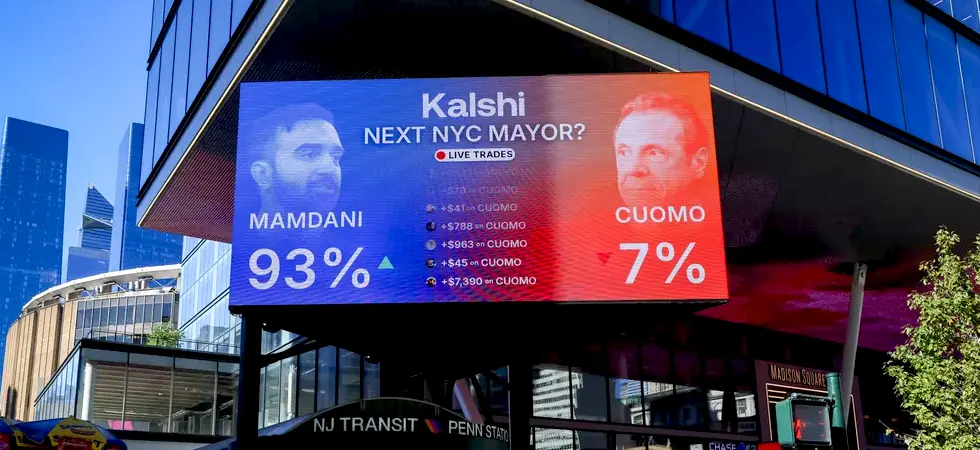
Do prediction markets have fees?
Yes, and the structures differ enough to matter. Check before you deposit.
Trading fees apply per transaction on some platforms. Profit fees take a cut of what you win. PredictIt charges a 10% fee on profits from profitable positions, plus a 5% fee on the amount withdrawn.
Withdrawal fees apply on some platforms, not others. Spread and liquidity costs are the hidden ones. In a thin market, the buy-sell gap can cost more than any listed fee.
Crypto transaction costs come into play on crypto-native platforms, where network fees apply on top. Always check each platform's fee page before depositing or trading. The PredictIt fees page is a good example of how a platform sets this out.
How accurate are prediction markets?
Often good. Not infallible.
The case for them is simple. They aggregate many views, all with money at stake. That sharpens judgment. And they update fast. A market can reprice within seconds of breaking news, well before a poll or a model catches up.
The case against is just as real. Low liquidity distorts prices, because a handful of trades can move a thin market. Hype and bias creep in on emotive topics. Limited participation narrows the crowd you're supposedly aggregating.
And unclear resolution criteria can produce a result that feels wrong even when the rules were followed. Treat market prices as a useful signal, not a forecast you can bank. Academic work on prediction market research explores both the strengths and the limits.
Can you make money on prediction markets?
Some people do. Plenty don't.
Profit depends on research, timing, liquidity, fees, and risk management. All five. An edge in one gets eaten by weakness in another. Fees grind down frequent small trades.
Prediction markets are risky. They should not be treated as a reliable way to generate income, and users can lose money. Be skeptical of anyone promising daily or monthly returns. That's a sales pitch, not a strategy.
If you're starting out, a play-money platform costs nothing and teaches the same skills.
Popular prediction market platforms
Short profiles of the four platforms most US traders encounter.
Kalshi
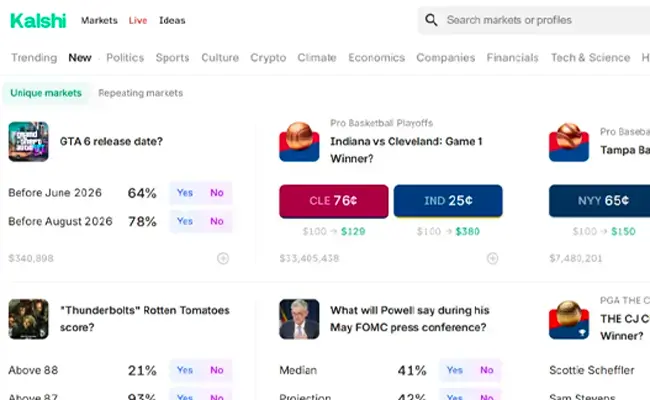
Kalshi is a US-focused event-contract exchange regulated by the CFTC as a designated contract market. That regulatory status is its defining feature. It lists thousands of contracts across economics, politics, culture and sports. It expanded internationally in late 2025. Its sports contracts have drawn the most state pushback, and access to those is restricted in a few states.
Polymarket
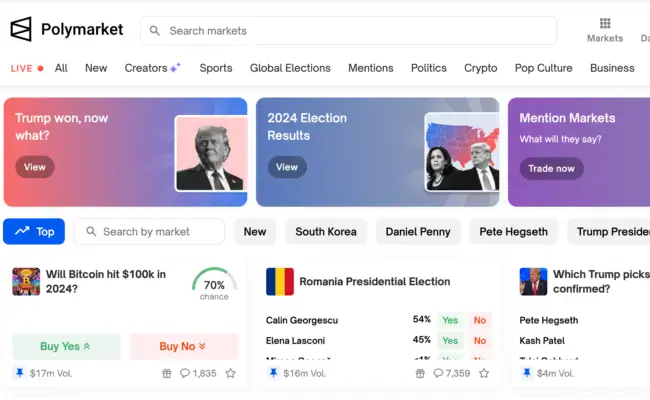
Polymarket is the fiat-based US event-contract exchange platform, best known for politics, crypto and world events. It was closed to US traders for several years. That changed after it acquired the licensed exchange QCX. Polymarket US now operates as a CFTC-regulated venue across 40-plus states, with mandatory identity checks. Note the split: the original global platform is still geo-blocked for US residents. Trading settles in stablecoin. That suits people already comfortable with crypto rails, much like the bitcoin betting sites we cover elsewhere.
PredictIt
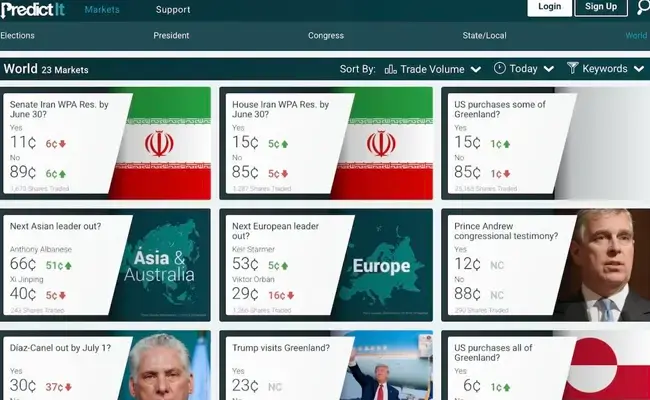
PredictIt is the political specialist, and the oldest continuously operating market of its kind for US residents. It has academic provenance and a long election-forecasting record. It won a federal court case, relaunched, and is available in all 50 states. Two limits define it. A $3,500 position limit per contract, and a narrower catalog focused on politics rather than sports. If elections are your interest, our political betting coverage pairs with it.
Manifold Markets
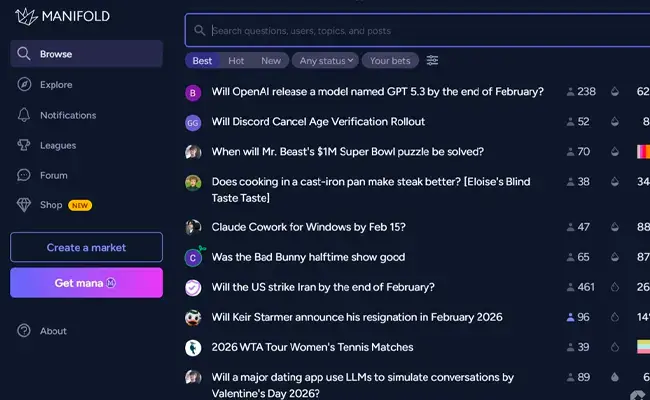
Manifold is the community-driven option, where users create their own markets on almost any topic. The social and forecasting angle is the point. Crucially, it runs on play money, so there's nothing at financial risk. So it's the natural starting place. Learn how market pricing works before committing real funds anywhere else.
Trade responsibly
Prediction markets put real money at risk. Only commit what you can afford to lose. Treat losses as the cost of participating, not something to chase.
If betting or trading stops being fun, help is available. Reach the National Council on Problem Gambling at ncpgambling.org or call 1-800-MY-RESET (1-800-697-3738).