Imagine you want to place a bet today on who will win the next Super Bowl. Or which player will win next season's NBA MVP. This is a Futures Bet - a wager on events that will be decided weeks, months, or sometimes years from now.
A futures bet is simply a bet on future events. Instead of betting on a single game, you're betting on long-term outcomes like league champions, individual awards, or season-long player performances. These bets keep you connected to your favorites sports all year round and often come with much bigger potential payouts than regular bets.
In this guide, we'll break down exactly what a futures bet is, how it works, the most common types, real examples, advantages and disadvantages, and practical tips so you can approach them confidently.
While our Online Betting Guides covers every wager type in detail, this section focuses specifically on how to approach futures betting.
What is a futures bet?
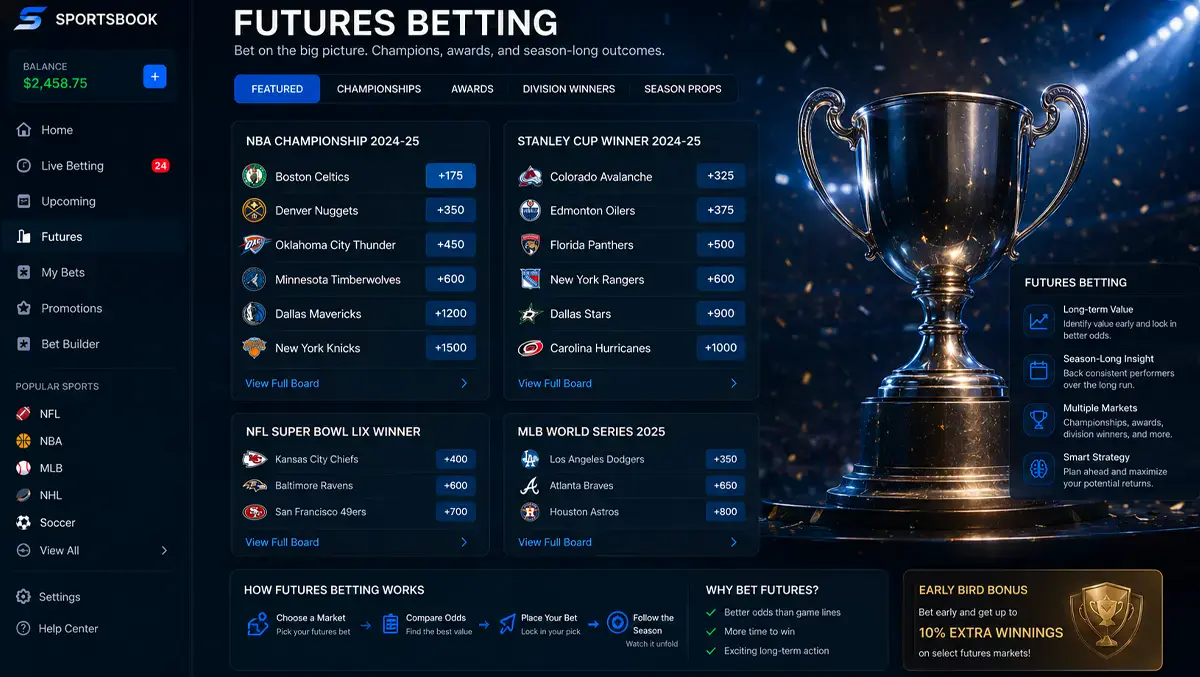
Futures betting is about wagering on an outcome that’s still far from being decided. This doesn't mean the event has to be months or years away, it could kick off tomorrow. It just has to be before the outcome is decided. Examples include predicting NFL division winners, college football bowl champions, NBA Finals victors, World Series champions, Golf Major winners, and more.
How futures bets differ from regular bets
Most people start with standard bets: picking the winner of tonight's game, betting the spread or taking the over/under on points totals. These are short-term wagers settled within hours.
Example: A $50 futures bet at +800 odds would return $450 total ($400 profit + your original $50 stake) if it wins.
A futures bet, focuses on longer-term outcomes. Your money stays on the table until the event settles - sometimes for an entire season. This longer time-frame can create bigger odds and potential payouts, but it also introduces more variables like injuries and trades which could hamper your bet.
There are three major ways in which Futures bets are different to regular bets:
- Time horizon - Your money could be tied up for a long time. A Super Bowl futures bet placed in September won't be decided until February
- Potential payout - Because the outcome is uncertain and far away, odds are usually much longer. A team might be +800 to win a Championship before the season starts but shorten to +200 when they get off to a good start.
- Number of variables - Many things can change: injuries, trades, coaching changes, hot and cold streaks, even entire seasons being disrupted.
Think of regular bets like sprinting - quick action and fast results. Futures bets are more like a marathon. They reward patience, research, and the ability to see the big picture.
Let's say you make a bet on the Los Angeles Rams to win the next Super Bowl at +750. If they go on to win it in February, you win big. If not, the bet loses. No in-game drama - just a patient wait for the end result.
The long-term nature is why futures are so popular. They keep fans invested in the competition all year round, even during the off-season.
The magic of futures betting
The magic of futures betting lies in the fact that you could win really big if you have a good feeling about something. Especially an underdog. If you had bet on Leicester City to win the 2016 Premier League before the season started, you would have received odds of +500000 ($100 bet returns $500,000). As the season went on, Leicester's odds shortened and shortened and by the last few weeks they were odds on favorites. Those lucky punters at the start of the season received massive payouts. Several bettors (mostly Leicester City fans) received sums in excess of $100,000. Those fans won life changing money on top of their favorite team winning the title.
As a Golf fan, one of my finest ever Futures bets was on Gary Woodland to win the 2019 US Open at odds of +11000. I liked the way Woodland was playing and felt he was good enough to win a Major. It wasn't a 'hole-in-one' though as I had backed him at the previous PGA Championship, a bet which lost.
My winnings were nothing in comparison to one high roller who won almost $1.2m on Tiger Woods winning the 2019 Masters at odds of +1400. Two days before tee off, a bettor placed $85,000 on the outcome. It is one of the highest ever payouts from a single wager.
Common types of futures bets
There are a variety of Futures markets. Here are the most popular ones:
1. Championship winner markets
The most popular futures bet. You pick the team that will win the entire league or tournament (Super Bowl, NBA Championship, Premier League, World Series, etc.). These markets are available almost year-round and offer some of the longest odds.
- NFL Super Bowl Winner
- NBA Champion
- English Premier League Winner
- MLB World Series Champion
These often offer the biggest odds before the season starts when underdogs have time to surprise everyone.
2. Conference or division winners
Slightly less risky and potentially more predictable than betting on the overall champion. You might bet on a team to win the AFC or AL East, for instance. These are great middle-ground options.
3. Individual player awards
Bet on standout performances:
- NFL MVP
- NBA MVP
- Heisman Trophy
- Golden Boot Winner in Soccer tournaments
These markets reward deep knowledge of individual talent and team situations.
4. Player performance futures
Bets such as:
- Will a quarterback throw over or under 4,200 passing yards?
- Will a baseball player hit more than 35 home runs?
- Rookie of the Year races
These often use over/under lines and can be excellent for statistical bettors.
5. Specialty and prop futures
Fun and sometimes quirky options like:
- Total regular-season wins for a team (over/under win totals)
- First coach fired
- Draft position for a top prospect
These markets often have high entertainment value and can be available for very long periods.
Real-world examples of futures bets
I mentioned Leicester City and my Gary Woodland bet. Let's make this concept concrete with a couple more stories.
The long-shot champion
One of the most famous future bets ever placed was by Gerry McIlroy, father of Rory. Gerry made £100,000 from a 500/1 bet he placed in 2004. The bet was that Rory would win The Open Championship golf tournament within the next 10 years. At the time, Rory was 15.
Time was running out for the bet to land when in 2014, McIlroy won The Open and his dad scooped the 100k. Another bettor from McIlroy's hometown won £50,000 with a similar bet. He bet £200 at odds of 250/1 that McIlroy would win The Open by the age of 50.
In a similar bet, Lewis Hamilton's father and friends collected £125,000 after they bet on him to win a Grand Prix by the age of 23. Many bookies take these kind of speculative bets, usually with a stated time frame. More often than not, they come to nothing but sometimes the punters are right with their foresight.
Division domination: Early in an NFL season, one team looks clearly superior in a weak division. Betting them to win the division at -150 or better can be a smart, lower-risk futures play compared to the overall championship.
Player prop future gone wrong: Betting a star pitcher to win the Cy Young Award looks smart in April — until he suffers a season-ending injury in June. This highlights one of the biggest risks in futures: things can change dramatically.
Hedging opportunity: You bet on Team A to win the championship in September at +1200. By January they reach the final. Some bettors then place a smaller opposing bet on the other finalist to guarantee profit no matter the result. This is called hedging.
How to place a futures bet (step by step)
- Find the market: Look for sections labeled "Futures" or "Future Odds", usually found in the drop down menu of each sport on a betting site.
- Compare odds: Shopping different books can make a meaningful difference with this type of bet. One site may be offering significantly better odds on your selection.
- Understand the rules: Check settlement details. What happens in case of ties or unforeseen circumstances like the event not finishing.
- Place the bet and wait: This is the hardest part for many people - patience.
Odds move constantly as new information emerges. A star player getting injured can cause a team’s championship odds to drift from +400 to +1200. Public betting can also push popular teams to shorter odds.
Most futures bets are “all-in” once placed, though some sportsbooks offer partial cash-out options as the season progresses. Always check the specific rules for settlement.
Tip: Some bettors like to note down why they placed a futures bet and refer back to it if any mid-season doubt creeps in.
The advantages and disadvantages of betting on future events
Advantages:
- Massive potential payouts compared to single-game bets.
- Keeps you engaged with your sport year-round.
- Opportunities to find value before the market adjusts (for example, before the season starts)
- Less emotional intensity than live or same-day betting.
Challenges
- Your money is tied up for a long time.
- Things change - star players get injured, teams blow up mid-season.
- Higher variance.
- Requires patience.
Understanding these trade-offs helps you decide when futures fit your betting style. If you hate waiting, stick mostly to shorter-term bets. You can read our guide to Moneyline bets for more information. If you enjoy research and big-picture thinking or even just backing a hunch, futures can be very rewarding.
Smart approaches to futures betting
Successful futures bettors treat this like a research project rather than a gamble. Key habits include:
- Study advanced stats and projections (not just last year's standings)
- Pay close attention to Roster changes, coaching, and schedule strength.
- Consider hedging later in the season if your position changes dramatically.
- Consider placing a smaller wager than a regular bet because of the duration and the higher risk.
Tip: Consider Parlay Future bets. Instead of just picking the winner of the Premier League, combine it with the winner of the Champions League, Spanish League and even the FIFA World Cup. This keeps you engaged in different competitions and for longer. It also skyrockets the odds. You would only need a small stake to win big.
For more on managing your overall betting approach, check out our Sports Betting Strategies. If you want to sharpen your research skills, our How Do Odds Work? guide breaks down how to read lines and implied probabilities effectively.
Common mistakes to avoid
- Betting purely on your favorite team out of loyalty (heart over head).
- Jumping in too late once the odds have already shortened.
- Ignoring injury risks and depth charts.
- Forgetting that “sure things” rarely exist in long-term markets.
Why futures betting can be rewarding
Futures betting has a way of turning casual fans into genuine students of the game. When you’ve got money riding on something that won’t be decided for months, you start paying attention to things you used to ignore — training camp battles, coaching changes, locker room chemistry, and those little storylines that play out over an entire season. It keeps you hooked in a completely different way than betting on a single game.
Whether you’re doing it purely for fun or actively hunting for an edge, once you get into futures, sports betting just feels bigger. It adds a whole new layer to how you watch and follow the games.
They’re definitely not for everyone. If you hate waiting or get impatient easily, futures might drive you crazy. But if you’re the type who enjoys the long game, loves doing your homework, and gets a real kick out of watching a bet slowly unfold over months, then futures can be some of the most satisfying bets you’ll ever place.