What is a point spread bet?
If you’ve ever flipped through an NFL bet slip on a Sunday, you’ve seen it. Right next to the moneyline and over/under, there’s a number with a plus or minus sign in front of it. That’s the point spread, and it’s probably the most popular bet type in American sports betting. Some people will tell you it’s the only bet they ever place.
Here’s the thing about point spread betting, though: it confuses a lot of new bettors at first. The numbers look weird, the favorites and the underdogs aren’t always obvious, and the whole “covering the spread” thing takes a minute to click. Once it does click, it’s actually one of the most fun ways to bet on sports. The games stay interesting all the way to the final whistle, even when one team is getting blown out.
Let’s walk through how point spread bets actually work, what those numbers mean, and how to read a spread line in any sport.
What is a point spread bet, really?
A point spread bet is a wager on the margin of victory, not just who wins the game. The sportsbook handicaps the better team by making them win by a certain number of points. That number is the spread. Your job is to decide whether the favorite will win by more than the spread, or whether the underdog will lose by less (or pull off an upset and win outright).
The idea behind it is pretty simple. If you just let people bet on which team would win, nobody would ever bet on bad teams playing great teams. Why would you put money on the Jets when they're playing the Chiefs? You wouldn't. The spread fixes that problem by giving the underdog a head start, which makes both sides of the bet attractive.
That's it. That's the entire concept. Now, let's get into how to actually read a spread.
Point spread explained: how to read the line
Every point spread bet has two sides: the favorite and the underdog. They're indicated by a minus sign and a plus sign, respectively.
Minus sign (-) means the favorite. The number after it is how many points the favorite has to win by. A team listed at -7 has to win by more than 7 points for the bet to cash. Plus sign (+) means the underdog. The number after it is how many points the underdog gets as a head start. A team listed at +7 can lose by up to 6 points, and the bet still wins. If they win the game outright, the bet also wins. Let's take a look at a quick visual.
| Kansas City Chiefs -7.5
New York Jets +7.5 |
The Chiefs are the favorite. They have to win by 8 or more for a bet on them to win. The Raiders are the underdog. They can lose by 7 or fewer, or win outright, and a bet on them cashes. If the final score is Chiefs 28, Jets 21, that's a 7-point win, and the spread bet on the Chiefs (-7.5) loses, while the spread bet on the Jets (+7.5) wins.
Easy enough? Most spreads come with a .5 on the end, which is called a hook. It's there for the same reason over/under totals use half-points. It prevents the bet from ending in a tie. If the spread was just -7 instead of -7.5 and the Chiefs won by exactly 7, the bet would be a push, and your money would be refunded. That's no fun. The hook eliminates that possibility.
How does a point spread bet work for payouts?
Spread bets are almost always priced around -110 on each side. That means you're laying $110 to win $100, or any other amount at the same ratio. Sometimes you'll see reduced juice at -105 or shaded lines at -115, sometimes all the way up to -120 depending on the book and the action, but -110 is the baseline you should expect.
This is one of the main reasons people prefer the spread over the moneyline, especially when betting big favorites. Imagine the Chiefs are listed at -450 on the moneyline. To win $100 on that bet, you'd have to risk $450. That's a brutal price even when you're confident. Take them at -7.5 on the spread instead, and you only risk $110 to win that same $100. The catch is that they have to win by more than 7.5 points. But if you think they're going to dominate, you're getting way better value on the spread.
On the flip side, betting the underdog on the spread gives you a built-in margin of safety. You don't need them to win. You just need them to keep it close. That's a much friendlier path to a winning ticket than picking an outright upset.
How to bet point spread in football
Football is the sport where point spread betting really shines. For a broader breakdown of football wagering, see our NFL betting guide. NFL spreads typically range from -1 to -14 or so, with most games landing somewhere between -2.5 and -7.5. College Football can see much bigger spreads, with massive favorites laying 20, 30, or even 40 points against overmatched opponents.
Certain numbers carry more weight in football than others. They are referred to as KEY numbers in sports betting. Three and seven are the two most important, because they represent a field goal and a touchdown. A lot of NFL games are decided by exactly 3 or 7 points, which means the difference between a spread of -2.5 and -3.5 is huge. Books know this, and they price spreads accordingly. If you can grab a favorite at -2.5 before the line moves to -3, that's a small but meaningful edge.
When it comes to how to bet on NFL point spreads, a few practical tips. Check the line early, because spreads move throughout the week as money comes in and injury news drops. Pay attention to the weather for outdoor games, since wind and rain favor the running games and the tighter scores. And don't forget about home-field advantage, which is usually worth about 2.5 to 3 points in the NFL.
Point spread bets in other sports
Football and basketball are the main sports for point spread betting, but spreads exist in just about every sport. The size of the spread changes based on how the game is scored.
NBA Point Spreads
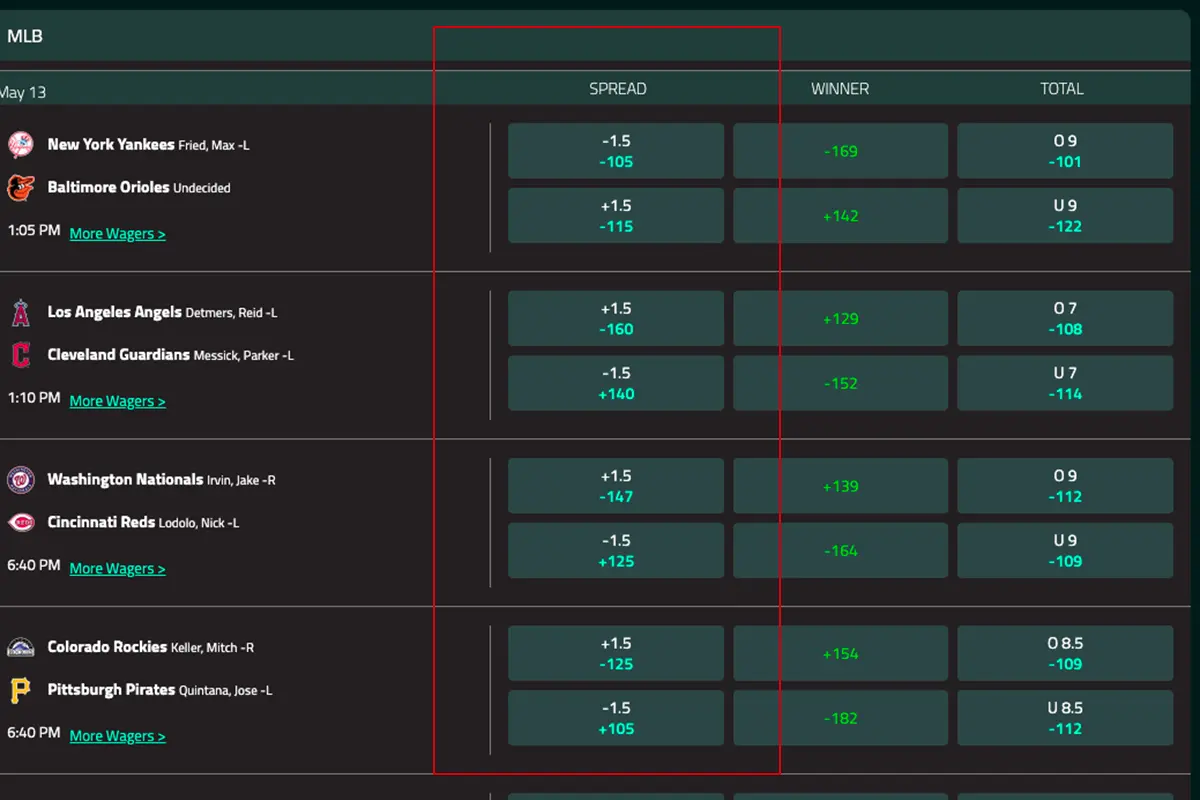
MLB Run Lines
NHL Puck Lines
Soccer Goal Spreads
Basketball spreads are typically a little bigger than football spreads because NBA games are higher-scoring overall. A typical NBA spread might be -5.5 or -7.5, but you'll see spreads as large as -15 or more when a top team faces a tanking opponent. The Celtics laying -8.5 against the Wizards means Boston needs to win by 9 or more for the spread to cash.
Baseball uses a fixed spread called the run line, which is almost always set at 1.5 runs. The favorite is -1.5 (has to win by 2 or more) and the underdog is +1.5 (can lose by 1 run or win outright). Because the spread is so small and the price tends to vary more than in other sports, run line betting can be a way to grab better odds on heavy moneyline favorites.
Hockey works exactly like baseball, just with a different name. The puck line is set at 1.5 goals, with the favorite at -1.5 and the underdog at +1.5. If you back the favorite, they have to win by 2 or more. Take the underdog and they can lose by 1 or win outright.
Soccer spreads are usually called goal spreads or sometimes Asian handicaps, and they can come in halves or even quarters of a goal. A Premier League favorite might be listed at -1.5 goals, meaning they need to win by 2 or more for the bet to cash. Underdogs can get +1.5 or larger handicaps in lopsided matchups, especially in cup competitions where smaller clubs face top-flight opponents.
Sports bet point spread meaning: when it makes sense
The point spread is at its most useful when you're dealing with a lopsided match-up. Heavy moneyline favorites cost a fortune to bet, and small underdogs don't pay much. The spread evens both sides out and gives you a more reasonable risk-reward ratio either way.
You're best off taking a favorite on the spread when you think there's going to be a blowout. If you wan't a deeper look at when each makes more sense, check out our moneyline vs. point spread breakdown.
If you expect a team to win by two touchdowns, getting them at -7.5 makes a lot more sense than risking a fortune on a -450 moneyline price. Conversely, you're best off taking an underdog on the spread when you think the game will be closer than the books expect. You don't need an upset. You just need a competitive game.
The spread is also a better option in games where you don't really have a strong opinion on the winner, but you do have a feel for how the game will play out. Maybe you think two evenly matched teams are going to grind out a one-score game. That kind of read is hard to capitalize on with a moneyline, but it's perfect for the spread.
A few spread betting tips worth knowing
There's no foolproof formula for spread betting, but a few principles tend to hold up. For a more comprehensive look at sports betting strategies beyond just spreads, there's a deeper guide worth checking out.
Shop your lines. Spread numbers can differ slightly from book to book, and that half-point matters more than you think. If one sportsbook has the Chiefs at -7 and another has them at -7.5, take the -7 every time. Over the course of a season, those half-points add up.
Bet the spread early when you like the price. Spreads move all week as money comes in. If you see a number you love on Tuesday, don't wait until Sunday to bet it. By Sunday morning, the line might have shifted three points against you.
Don't sleep on the underdog. Underdogs cover spreads at a surprisingly consistent rate, especially in games where the public is hammering the favorite. When a team gets tons of public love, the line often gets inflated beyond where it should be. That's a spot where the dog has real value. The public loves betting on favorites; keep an eye on it throughout the week, and you'll see underdogs getting tons of points and value.
Watch for key numbers. In the NFL, that means 3, 7, 10, and 14. Try to get a favorite under those numbers or an underdog over them whenever you can. In the NBA, key numbers don't matter quite as much because basketball doesn't have natural scoring increments like field goals and touchdowns.
Wrapping up the point spread bet
A point spread bet is one of the most popular wagers in sports betting for a reason. It even the playing field between mismatched teams, offers more attractive odds than betting moneyline favorites, and keeps games interesting long after the outcome is decided. Whether you're betting NFL Sundays, NBA Tuesdays, or a Premier League weekend, the spread gives you a clean, simple way to put money on what you think will happen.
Read the line. Spot the favorite and the underdog. Decide whether the favorite wins by more than the spread, or whether the underdog keeps it close enough to cover. Pay attention to key numbers, shop your lines, and bet early when you find a price you like. Do those things consistently and the point spread can be one of the most rewarding bets on the board.