
In the pantheon of online sports wagering, there are a variety of mediums for eligible customers to place their wagers, and of course, finding the right fits for them. Arbitrage wagering is one such category among the different sports betting strategies where savvy customers are able to explore both of their options in a matchup. Of course, for more introductory information than this guide, our guide to how sports betting odds work available at OSB is an excellent resource for those looking to learn more.
What is arbitrage betting?
Arbitrage betting, sometimes called “sure betting,” or “hedging your bets,” is a strategy where bettors place wagers on both sides of a particular matchup to ensure that there is a guaranteed profit. Indeed, the concept is geared toward creating a significant mathematical advantage regardless of the outcome of the event. What’s more, this strategy is an excellent way to find pricing differences in the matchup that can be to your advantage, regardless of the outcome.
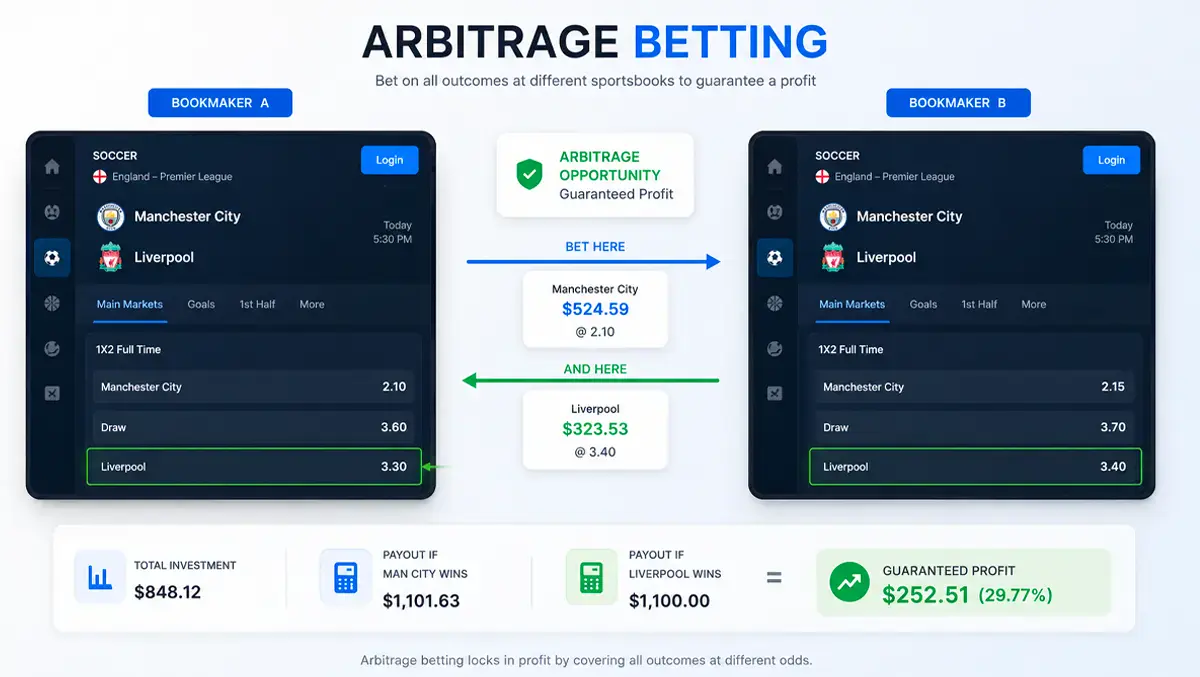
A popular OSB trope, let’s go into an example for arbitrage wagering and how it could potentially help your next wagering endeavor. Take a cross-conference matchup between the New York Jets and New York Giants. The Giants yield a +150 underdog role, while the Jets come in narrowly at -130. By carefully calculating wager amounts on both sides, a bettor may be able to secure a small profit no matter which team wins. Sort of like taking out an insurance policy even though you might not need it. In fact, arbitrage wagering works very well in markets with only two possible outcomes as opposed to futures or categories where there are perhaps multiple winners. This is why having a handy resource like your betting slip is a must to keep track of potential outcomes.
Arbitrage betting: a visual guide
Though the concept can perhaps be straightforward to some, a visual diagram of a certain matchup is a necessary device to help fully understand the concept of arbitrage wagering, especially to visual learners, and who doesn't like a fun arbitrage wagering diagram?
| Outcome 1 | Outcome 2 |
|---|---|
| Win By Team A | Win By Team B |
| Sportsbook X | Sportsbook Y |
| -275 | +450 |
| Stake: $80 | Stake: $20 |
| Total Payout: $109.09 | Total Payout: $110 |
| Profit Off This Bet: $39.09 | Profit Off This Bet: $90 |
| Total Arbitrage Profit: $9.09 | Total Arbitrage Profit: $10 |
Looking at the above chart, you can see the minute differences in potential profit here given wagering on different outcomes for the given contest. Of course, that's the point of arbitrage wagering in many ways is finding a way to profit off of the outcome, even though the payoff is often much smaller than if you simply won the wager outright.
In the above example, you should be looking at the combined investment, which is $100: $80 on the favorite and $20 on the underdog. So, in this case, no matter who wins, there will be a small profit to be made on the outcomes here. Of course, there are instances where this does not make sense, like the total profit being less than the amount wagered or heavily favoring one side or the other, but in some instances, arbitrage wagering can be a useful tool.
Though the profitable payout here might look small on the surface, on an aggregated level, this can add up over multiple instances. Something to keep in mind, though, is the amount being wagered and how it can potentially have a bigger payout when you are wagering on both sides.
How to use an arbitrage betting calculator
An arbitrage betting calculator helps bettors determine how much money to place on each side of a wager to secure a guaranteed return. Instead of calculating payouts manually, the calculator automatically adjusts stake amounts based on the odds available at different sportsbooks.
For example, if Sportsbook A offers Team A at -110 while Sportsbook B offers Team B at +120, an arbitrage calculator can show exactly how much to wager on each outcome to lock in a small profit regardless of the final result.
Most arbitrage betting calculators work by converting odds into implied probability percentages and comparing the combined total. If the combined implied probability falls below 100 percent, an arbitrage opportunity may exist.
Understanding when to use arbitrage wagering
So, when is a good time to break out the handy arbitrage wagering textbook and guide like the one here at OSB? Well, there are a couple of instances that make sense. First, when you are doing your background research on an event, and there is a noticeable pricing difference between two sportsbooks on the same event. Indeed, this could make sense for something like Super Bowl betting, where the attention and stakes are high with a plethora of information available. So, take, for instance, two outlets that offer a somewhat larger dispersion of odds on the Big Game and use this to hedge to your advantage if it makes sense.
Introducing another hypothetical, there are also instances where the odds can move and change on the fly. Like a Super Bowl showdown, where an injury report reveals how markets can move on the fly during the week, which can perhaps create an arbitrage opportunity. This also brings up the point of not having to wager both teams at once, but perhaps waiting as the week plays out and odds shift.
Another situation where arbitrage wagering is advantageous is when one sportsbook is slow to update. If you see this situation, perhaps this could be a great time to again use this to your advantage, as opposed to waiting until the lines correct themselves. Another instance where this can be useful is when you are combining promotions or other items into a wager where hedging both sides makes sense and actually produces a reasonable outcome for both. Finally, and this goes for many people, but arbitrage betting is most effectively utilized as a skilled tool versus an emotional wager trade-off, where one would calculate the effective payout to make sure it meets the desirable outcome.
Exploring the cons of arbitrage wagering
While arbitrage betting can sound appealing in theory, finding consistent opportunities is often much harder than it is perhaps made out to be and trickier than beginners expect. For example, sportsbooks move quickly, and odds discrepancies can change dynamically, so those differences seen at sportsbooks will not exist for a very long time and only for short windows. In many cases, the sportsbook markets will correct themselves almost immediately if a consumer does not immediately react when an arbitrage opportunity presents itself.
Another obvious challenge is that the profit margins themselves are usually relatively small. Even when a guaranteed profit exists, the return may only amount to a few small percentage points compared to the total amount being wagered. Because of this, arbitrage betting often requires larger bankrolls to generate meaningful returns over time. Moreover, timing can also be an issue in these instances, as a bettor may successfully place one side of a wager only to see the odds change before the second bet is submitted. Typically, when that happens, the arbitrage opportunity can disappear completely and potentially leave the bettor exposed on one side of the matchup.
At the end of the day, arbitrage wagering requires patience, organization, and careful bankroll management. It is less about predicting winners and more about identifying pricing inefficiencies before sportsbooks adjust their markets.
Understanding if arbitrage wagering is a fit for you
Now, as Bob Dylan would say, it's time to "bring it all back home" in the OSB arbitrage wagering rundown. Arbitrage betting may appeal to bettors who prefer a more mathematical and strategy-driven approach rather than relying purely on predictions or instincts. Instead of trying to pick winners, arbitrage bettors focus on identifying pricing differences between sportsbooks and managing risk carefully and correctly.
More specifically, this style of wagering can be a fit for people who fall into a couple of categories. This includes those who enjoy statistics, numbers, and calculations while also being patient and detail-oriented. Moreover, customers who enjoy comparing odds over multiple sportsbooks while also preferring smaller and more consistent returns are typically likely to end up ahead here. Meanwhile, those who are comfortable managing multiple accounts and tracking bets closely while also treating sports betting more like investing or market analysis are often prefer this strategy.
Ultimately, arbitrage betting may also appeal to bettors who want to reduce variance. Because the goal is often to create a situation where profit is possible regardless of the outcome. However, sometimes arbitrage wagering can feel less emotional than traditional betting strategies focused on predictions or fandom. At the same time, arbitrage betting is not necessarily ideal for casual bettors looking for entertainment or large payouts. The process can require quick decision-making, constant line monitoring, and careful bankroll management. For many people, the appeal comes from the challenge of spotting market inefficiencies rather than simply picking winners on game day.
Is arbitrage betting legal?
Arbitrage betting is generally legal in most jurisdictions because bettors are simply placing wagers using publicly available odds. However, while the strategy itself is legal, some sportsbooks may restrict or limit accounts that consistently use arbitrage betting strategies.
Many sportsbooks monitor betting patterns closely and may reduce wagering limits, delay bets, or restrict promotional access for customers who regularly exploit pricing differences between sportsbooks. Because of this, arbitrage bettors often spread wagers across multiple sportsbooks and avoid drawing attention through repetitive betting behavior.