
I still shake my head when I think back to my very first moneyline bet. It was a random midweek soccer game years ago. I was sitting there staring at the odds, one team at -220 and the other at +180, with literally no clue what those numbers were supposed to mean.
I picked the team I thought would win, put some money on them, and they won. When the payout came in I was pleased, but I didn't know whey I got back exactly what I did. The numbers still didn’t make much sense to me.
If you're sitting there right now feeling the same kind of confusion as me, you're definitely not alone. Pretty much everyone goes through that stage.
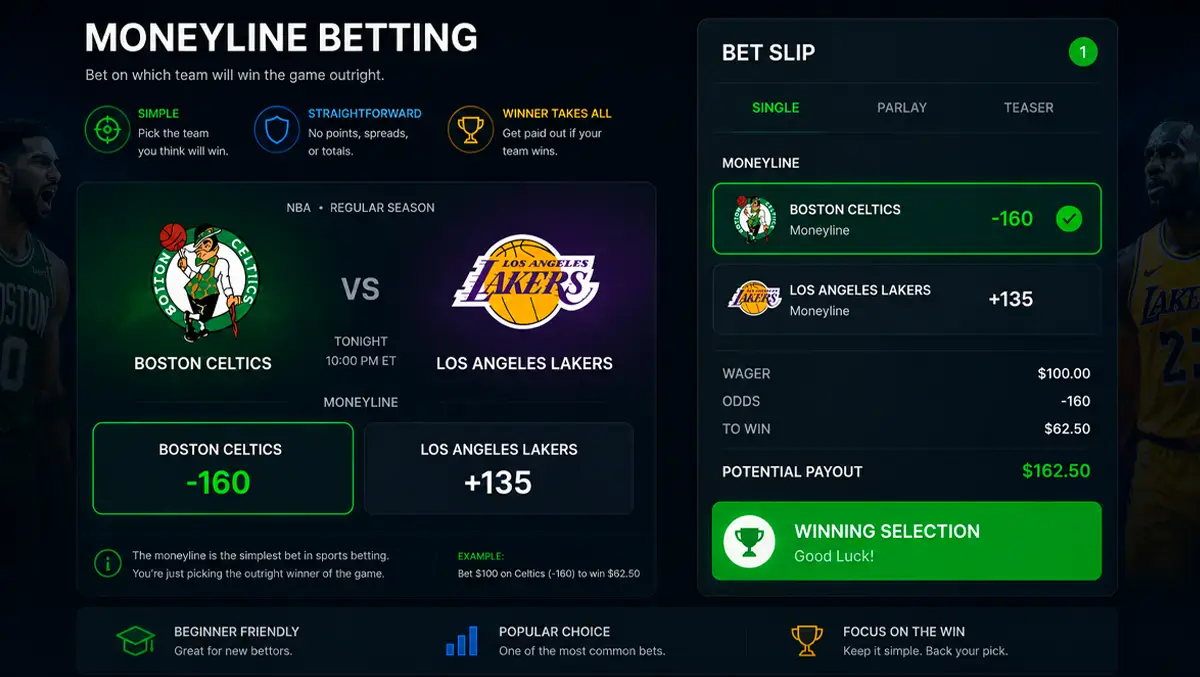
So let’s clear it up. A moneyline bet is one of the most straightforward and common ways to bet on sports. You’re simply choosing which team or player is going to win the game. That’s it. No spreads, no totals, no complicated rules. Just pick the winner.
This guide will walk you through everything in a way that actually makes sense. We’ll cover what a moneyline bet really is, how the odds work, how they look in different sports, real examples from my own experience, and practical tips that took me way too long to learn on my own. For information on other types of sports bets, check out our Types of Sports Bets – Complete Guide to All Betting Options You Have.
What is a moneyline bet?
When you place a moneyline bet (sometimes people say “bet on the moneyline”), you’re answering the most basic question in sports: who’s going to win? That’s the entire bet.
Sportsbooks use American odds with plus (+) and minus (-) signs to show two important things at once: who they think is more likely to win and how much money you’ll make if you’re right.
- The minus sign (-) is for favorites. You have to risk more money to win less profit because they’re expected to win.
- The plus sign (+) is for underdogs. You risk less to win more because they’re not expected to win.
An example could look somethihng like this:
| Team | Odds | Bet Amount | Profit |
|---|---|---|---|
| Lakers | -150 | $150 | $100 |
| Celtics | +130 | $100 | $130 |
It feels a bit complicated at first, but it becomes second nature pretty quickly.
How to read moneyline odds clearly
Let's use a real basketball example to make this clear.
Let's say the Phoenix Suns are playing against the Charlotte Hornets:
- Suns -175
- Hornets +145
If you bet $175 on the Suns and they win, you get your $175 stake back plus $100 profit. If you bet $100 on the Hornets and they upset the Suns, you get your $100 back plus $145 profit.
Here’s how the ranges usually feel in everyday betting:
- -110 to -150: Moderate favorite in a close game
- -180 to -300: Heavy favorite — you’re paying a premium
- +110 to +200: Solid underdog with a realistic chance
- +250 and higher: Big long shot that can really pay off nicely
Those numbers aren’t just thrown together randomly. They basically show what the sportsbook thinks is most likely to happen in the game.
Once you’ve spent some time with them, you can look at a moneyline and pretty much read the story behind the matchup — who’s expected to win and how confident the market is.
Moneyline betting in different sports
One of the best parts about moneyline bets is how well they travel across sports. Each one has its own personality.
Moneyline bets in basketball
NBA and college basketball games are perfect for moneylines because they’re high-scoring and full of momentum swings. A strong favorite at home might sit at -280, but put that same team on the road after playing the night before and they can become much more beatable. I’ve won some of my favorite bets spotting tired teams getting too much respect on the moneyline. The fast pace makes these games exciting to watch when you have skin in the game.
What is a moneyline bet in soccer?
Soccer usually offers three possible outcomes: home win, draw, or away win. This is often called a three-way moneyline. Betting on the draw at +220 or +280 can be surprisingly smart when two decent teams face each other and neither wants to take too many risks. Some of my best soccer wins came from correctly guessing gritty draws that most people didn’t see coming.
If you follow soccer closely, like me, you start noticing certain patterns as a season goes on. During the 2025/2026 Premier League season, Bournemouth and Leeds United became known as the ultimate draw specialists. They drew against each other early in the campaign, and both teams went on to grind out draws in tons of their other matches too. So when they met again in April, I thought “this has to be another draw, right?” Sure enough, it ended 2-2.
One of my biggest near-misses ever came on a low-stakes, high-odds moneyline parlay on English football. I got 13 out of 14 games right. Just one result away from a five-figure payout.
In baseball
Baseball moneylines are heavily driven by starting pitchers. A really good starting pitcher can turn an average team into a -180 favorite almost overnight. But if that same pitcher gets scratched with an injury or illness right before first pitch, the whole moneyline can flip in a hurry. This is why serious baseball bettors spend time checking probable pitchers and bullpen strength. Weather can matter too — wind blowing out can help hitters and change the entire complexion of a game.
You’ll also find moneylines in hockey (where overtime counts differently depending on the league), tennis (betting on individual players), MMA, boxing, growing esports scenes and match play golf. The principle stays exactly the same no matter the sport: you’re simply picking the winner.
Moneyline bets in football vs. basketball
Moneyline betting works similarly across sports, but the odds can look very different depending on the game.
In football, especially the NFL, moneyline favorites are often priced between -110 and -300 because scoring is lower and games are usually more competitive. For example, a -150 favorite would require a $150 wager to win $100.
Basketball moneylines can become much steeper, particularly in the NBA where stronger teams play more games and talent gaps are easier to identify. Heavy favorites may reach -500 or shorter against weaker opponents.
In both sports, a moneyline bet simply means picking the team that wins the game outright, regardless of the final score margin.
Moneyline vs point spread vs other bet types
People always ask how moneyline betting compares to spreads.
The big difference is this: with a point spread, the favorite has to win by a certain number of points (or goals) for your bet to pay out. On the moneyline, they can win by just one point — even the sloppiest, ugliest victory — and you still win your bet.
That straightforward “just win” rule is exactly why so many beginners feel more comfortable starting with moneylines.
Betting heavy favorites on the moneyline usually means you’re risking quite a bit of money just to win a small amount. That’s exactly why a lot of experienced bettors mix moneyline bets with spreads — they choose whichever one makes more sense for that specific game.
If you want to understand spreads better, our guide on point spread betting explained does a good job breaking it down.
Real payout examples you can picture
Let me show you how this actually works with a few real examples:
- If you put $100 on a team at -200, you only win $50 profit, so you get $150 back in total.
- Bet $50 on the same line and you’d make $25 profit ($75 returned).
- Betting $100 at +150 brings in $150 profit — $250 back in your account.
- $75 on +300 = $225 profit (that one feels nice when it hits)
After placing maybe ten or fifteen bets, you start to feel the risk versus reward without pulling out a calculator every time. Our article on How Do Odds work? goes deeper into how these numbers connect to real probabilities if you want to get sharper.
Stories from my own experience
Early in my betting days I made the classic mistake of hammering “safe” heavy favorites. I once put $100 on a team at -350 that was up big at halftime. They barely hung on to win. I only made about $28 and spent the whole second half stressed out. That game taught me that big favorites on the moneyline can go wrong, even if I got away with it that day.
On the brighter side, I’ve had days where I caught +500 underdogs in soccer, especially during cup games where the bigger team rested key players. Watching that late goal go in when you’re on the plus money side is a feeling that’s hard to beat.
These real experiences are what make moneyline betting stick with you. Some weekends you’re grinding out small, steady wins. Other times you’re riding the wave with the underdogs and enjoying the chaos.
Advantages and disadvantages of moneyline betting
The good side:
- Very beginner-friendly and easy to understand
- Available for almost every game in every sport
- Can be combined well in a parlay bet.
- Can deliver big payouts when you hit good underdogs
- No need to worry about exact margins or totals
- Quick to place and simple to follow while watching
The challenging side:
- Heavy favorites often give poor value for the risk
- You sometimes have to tie up larger amounts for smaller returns
- No margin for error, your side has to actually win
- Can feel expensive during cold streaks if you’re mostly betting favorites
Understanding both sides helps you decide when a moneyline makes sense for a particular game.
Practical tips that actually help beginners
Here are some things I wished I knew earlier:
- Start with smaller stakes while you’re still getting comfortable with how the odds feel in real games.
- Be very picky with heavy favorites. Winning $30–40 on a $100 bet gets old fast unless you have a strong reason.
- In basketball, always pay attention to back-to-back games and rest situations — teams playing the second night of a back-to-back are often more beatable than the odds suggest.
- In baseball, the pitching matchup is usually the biggest factor by far. A strong starter can completely change the outcome.
- It helps to look at home and away records, how teams have been performing lately, injury reports, and fatigue.
- Try not to bet on your favorite team with your heart. Only pull the trigger if the number actually makes sense.
If you’re new to betting and consider yourself a beginner, How to Start Betting on Sports is one of the most useful things you can read early on.
Common moneyline mistakes and how to avoid them
- Betting on every favorite because it feels safe
- Ignoring situational factors like motivation or weather
- Jumping on every big underdog without doing any homework
- Not understanding what the plus and minus numbers actually mean
- Chasing losses by betting bigger and bigger plus-money tickets
Steering clear of even a couple of these habits will put you ahead of most new bettors right away.
Why moneyline bets are worth getting good at
Once you truly get what a moneyline bet is and how it works, it quickly becomes one of the most practical tools in your betting arsenal. It’s straightforward enough that complete beginners can start using it right away, yet it still holds plenty of depth for those who have been betting for years.
What I like most is how it changes the way you watch a game. Whether you lean toward steady favorites or prefer chasing value with underdogs, moneyline bets make you pay closer attention to things you might have overlooked before, coaching adjustments, player matchups, signs of fatigue, and the small storylines that unfold over the course of a match.
It probably won’t make you rich overnight, but it does turn you into a sharper, more observant sports fan. At least that’s been my experience. Those little moments of deeper understanding, combined with the occasional solid payout, are a big reason why so many of us keep coming back to it.
Moneyline betting sounds straightforward because all you’re doing is picking a winner, but anyone who’s spent time betting regularly knows there’s a bit more to it than that. Some days the obvious pick gets the job done, and other times the value sits with a team most people have already written off before the game even starts.
A big part of improving is simply paying attention over time. You start noticing how certain odds shift during the week, which teams the public tends to overrate, and when a number just feels slightly off. That kind of feel only really comes from watching games, following the markets, and making enough bets to understand how things actually play out.
It also helps not to overthink every single wager. Some bettors get too caught up chasing perfect systems when consistency and patience usually matter more. Stick with it, trust your research when you’ve done the work, and try to enjoy the ups and downs that come with betting on sports in the first place.